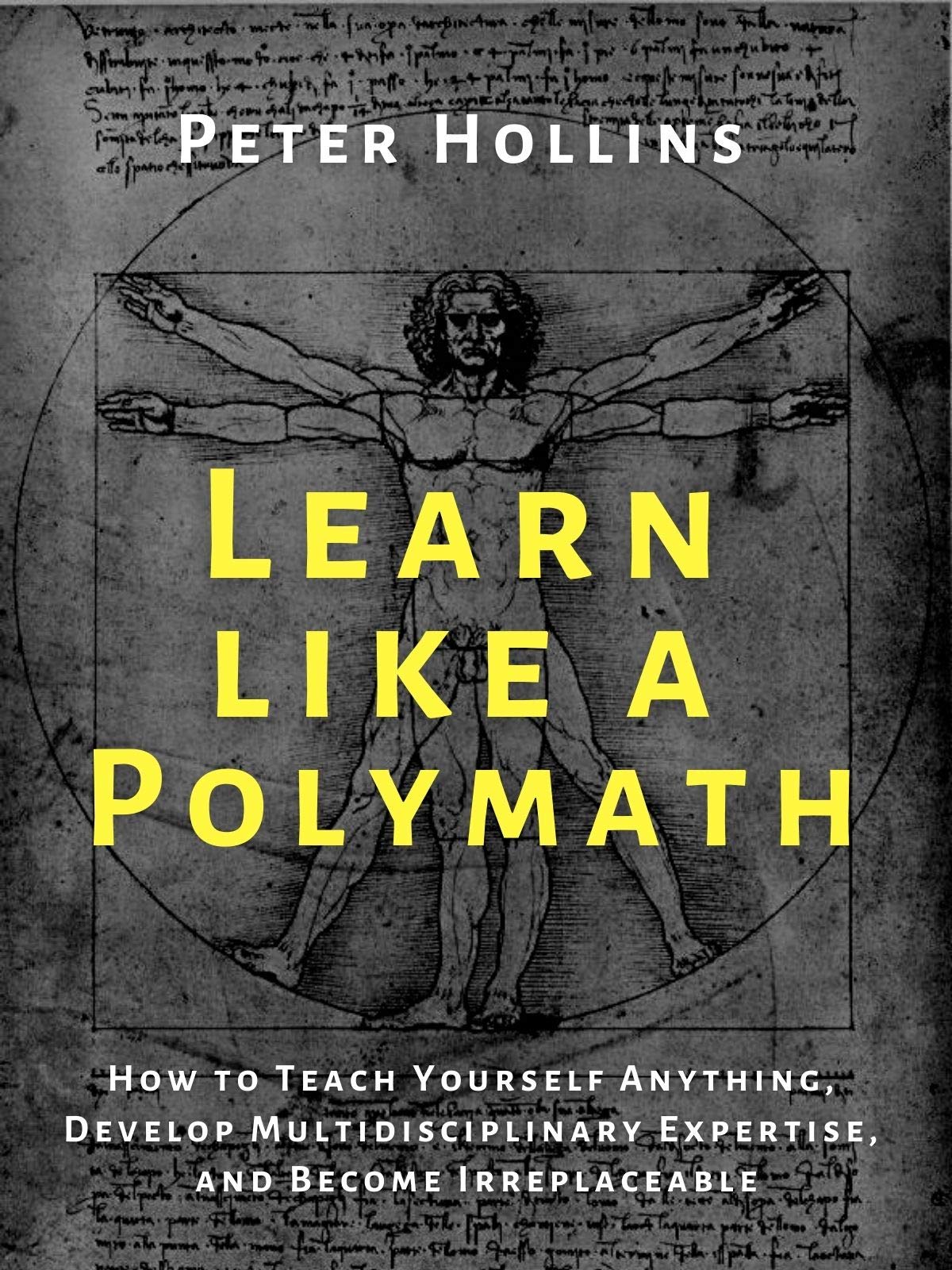
I’ve recently read Learn Like a Polymath: How to Teach Yourself Anything, Develop Multidisciplinary Expertise, and Become Irreplaceable, by Peter Hollins, and thought it had quite an interesting overlap to do with writing.
It’s a short book, covering what polymathy is (and isn’t), the core idea of skill transfer, and how to break knowledge down and adopt the right mindset.
The short version, is that for practical reasons polymathy isn’t simply high intelligence (for many reasons, not the least of which is the difficulty in defining intelligence). Rather, it is the ability to study one area and then abstract learnt skills to apply in other areas and situations. An example would be studying creative writing and applying it to business writing, or studying history and applying it to writing fantasy.
Hollins goes further in defining the types of transfers, about thinking in analogies and using tools like mind-mapping, generally keeping an open and adaptable mind, and thinking in experiments. (That last is pretty much bread & butter for what I do in my day job).
I think some of those concepts would be familiar to many authors, as the examples above indicate. While particularly prevalent in speculative fiction in all its myriad forms, any author at some point will research a topic to enrich a plot and adapt it to the novel, study people and motivations, study language tools and implement them, learn marketing (whether you like it or not), and probably a handful of other skills.
There is the concept of a “T-shaped person”, ie having broad general knowledge and deep expertise in one area. The expertise for authors would be the craft of writing, and the broad knowledge would be all the subjects they pull in to enrich their settings, characters, plots, etc. Polymathy is described as a π or comb shape, as having several areas with deep knowledge. But in reality, you don’t have to become an world-leading academic expert; the Pareto principle applies: you can spend 20% of the effort to understand 80% of the material, which is often good enough for writing in fiction. I think it is a matter of degree, not absolutes — if you know enough about an area to adapt it convincingly into fiction, you have successfully performed a knowledge transfer. It’s the adaptation that’s the key differentiator, and why fiction provides this vehicle. You aren’t just studying a topic and writing a paper about it, but actively inspecting and modifying the concepts that you have learnt during socio-political world-building.
Another similar concept is that of being a generalist, rather than a specialist. If you aren’t familiar with Robert A. Heinlein quote about specialisation I suggest you memorise it. Although specialists might object, I find it puts what it is to be a human quite succinctly. Alternatively, the book named Range: Why Generalists Triumph in a Specialized World, by David Epstein also covers in depth the cross pollination between fields. Although not specific to writing, it makes a great reading for those interested in learning and cross-pollinating across fields to excel in creative, cross-disciplinary efforts such as writing.
I know an oft-given, well-meaning advice is “write what you know about“. I strongly disagree, and I base it on cough decades of reading and writing speculative fiction. Much better is the advice of “if you want to study and understand a subject, teach it“. I think writing comes under this heading. I often joke that writing about ancient Rome is just an excuse to study it, and it certainly gave me the impetus to invest more time and effort. It’s a concept the book calls of “problem-based learning”.
So where does that leave you?
The book is a quick read and has some insights and links to research and further reading. If you’re generally curious, it’s a good read (as is Range). Don’t expect a miracle recipe that will turn you into da Vinci, but it will strengthen your metacognition, your thinking about how you think, and perhaps help you make a more conscious effort in studying a topic and transferring learnt skills.
If you are an author of historical, speculative, fantasy, science, or other fiction, you should take a moment to call yourself a polymath and have the drink of your choice. We all know other accolades are too far between 😅
Enjoying the articles, but curious if I’m just full of it or really make use of those varied subjects? Happy to elaborate! Go meet Felix, the protagonist of the Togas, Daggers, and Magic series, an historical-fantasy blend of a paranormal detective on the background of ancient Rome.
You can Felix and his multi-faceted world on the free short stories and novels!
 FELIX THE FOX MYSTERIES
0 Comments