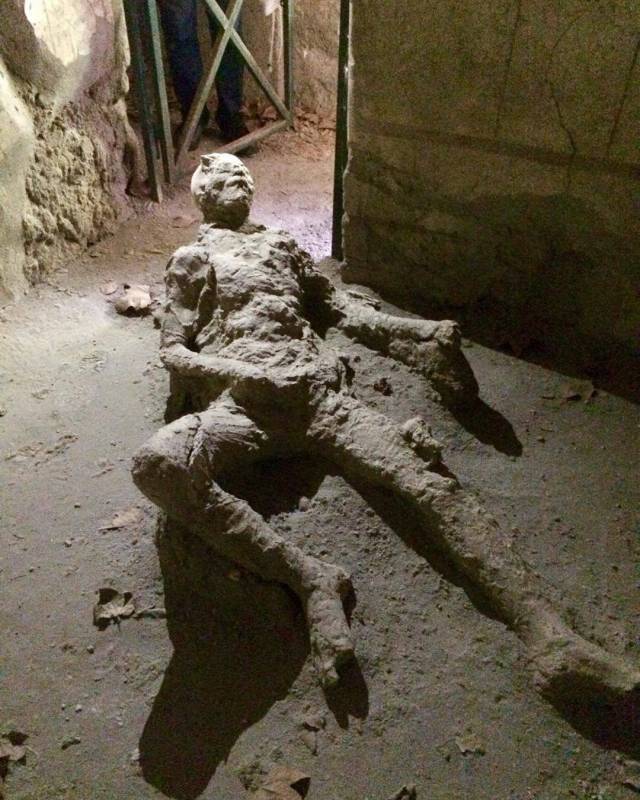
There’s a meme that’s been going around for a few years, about the cast of a man who died in Pompeii at the 79CE eruption of Mt Vesuvius. Pundits are quick to point at the posture, with a “haha, he died with a bang!” and other jokes about his own eruption.
The reality is that the man’s posture is an artefact of tendons contracting violently in the wake of the pyroclastic surge. When temperatures suddenly reached 500°c (930°f) water boiled away from soft tissue and caused the contorted pose.
Turns out that there were many causes of death. In this article I thought I’d cover some of those morbid ways (ha!), as well as some of the beautiful artefacts found recently, and the light the shed on the daily lives of Romans in the first century CE.
Study of the remains in Pompeii started in the 1860s and 1870s, when archaeologists led by the director of excavations Giuseppe Fiorelli realised that bodies were covered in ash and pumice, and then rotted away. They made plaster casts of the victims by pouring the plaster into the voids left by decomposed bodies.
This was applied not just to human bodies, but animals as well. Sometimes bones were caught in the plaster, and occasionally imprints of the clothes people wore. There’s a nice gallery here and here (that last link has a lot more info on Pompeii — including houses and the people).
More recently, there has been significant research into what happened to those who died. For everyone who thinks my stories are gruesome, the studies showed that Mount Vesuvius caused victims’ heads to explode, and one victim was found recently with their brain turned to glass. Yep, scientists have determined that while often brains become “saponified” — turned to soapy mix of fatty acids — in this case they became vitrified, to the point of being able to detect neurons when scanning it. Also, two lovely new words which should make it into every day conversation.
Most victims in Pompeii, however, died due to suffocation. The pyroclastic blast flowed mostly towards Herculaneum, and the people in Pompeii, according to written sources, had a couple of days to try to escape before more ash and pumice (and noxious gases) rained down on them. The time it took would explain the people found in various positions, seeking shelter together or just collapsed, and the effects of tendon and muscle contractions due to the heat on those postures.
Going beyond human and animal remains, the same plaster-filling technique has been applied to other voids — that left by furniture that has rotted away. A recent discovery of a room in a villa outside the walls of Pompeii proper, shed light on the lives of slaves.
/cloudfront-us-east-2.images.arcpublishing.com/reuters/RTJDVXID25OA7FNSXH75JZ4YSY.jpg)
Beyond the physical objects found, I particularly like this observation:
“It seems that control was primarily exerted through the internal organization of servitude, rather than physical barriers and restraints,” said Gabriel Zuchtriegel, the director of the Archaeological Park of Pompeii.
https://www.reuters.com/world/europe/new-find-throws-light-life-slaves-romes-pompeii-2023-08-20/
It shows that slavery, at least in households, was a state of mind. The situation would have been decidedly different in mines and galley ships. It also changed over times and places, as the history of Servile Wars (slave uprising) teaches. But, deplorable as that practice was, that practice wasn’t racially motivated (as in later centuries), and was commonplace across most nations in antiquity. These invisible mental chains seem to have been strong, even when the people had physical freedom. Though not always acceptable to modern readers, I think I balanced it well with Felix’s treatment of people as they are: he’s deferring to those who pay him even while sniggering about their shortcomings, and is always courteous and on the lookout for slaves he can bribe for information.
On the subject of slavery, Pompeii been a thriving city before the eruption, so naturally some finds predate the catastrophic end. Out at the necropolis at the gates of the city (a Roman practice to place graves on the roads leading into towns), archaeologists have uncovered “partially mummified” remains. There are several interesting things about this find, from the fact it’s a burial and not a cremation, to the plaque commemorating the man: he was a freed slave who later became a priest. His memorial inscription also makes references to plays in Greek, confirming the cross-cultural influences at the time. It’s a different kind of human drama, one that at least shows that some cases ended up well. Life is much more complicated than fiction can every convey. But then, maybe that’s why we life fiction.
Anyway, back to Pompeii. it’s worth noting that not all finds are gruesome, and most can be quite pretty, like mosaics, paintings, and jewellery. To make the transition easier, this review of recent finds still includes skeletons 🩻
There’s an interesting short video, but reading through the article you’ll note the interplay of daily lives. There was a painted lararium, the household shrine to the family deities. There are two painted stucco bas relief snakes. To us these may seem dangerous, but to ancient Romans (and many other culture in antiquity) snakes were a symbol of renewal (the shedding of skins), of healing (eg Aesculapius, the god of healing — see here for relevant mythology), or a connection to the underworld (all that slithering in ground borrows). Take is a reminder that what we perceive is coloured by our modern sensibilities, and may not reflect the ancient point of view.
Three skeletons were also found, huddled for shelter post the events. While damaged over the centuries, they hint at the human drama of two adults and a child seeking shelter together.
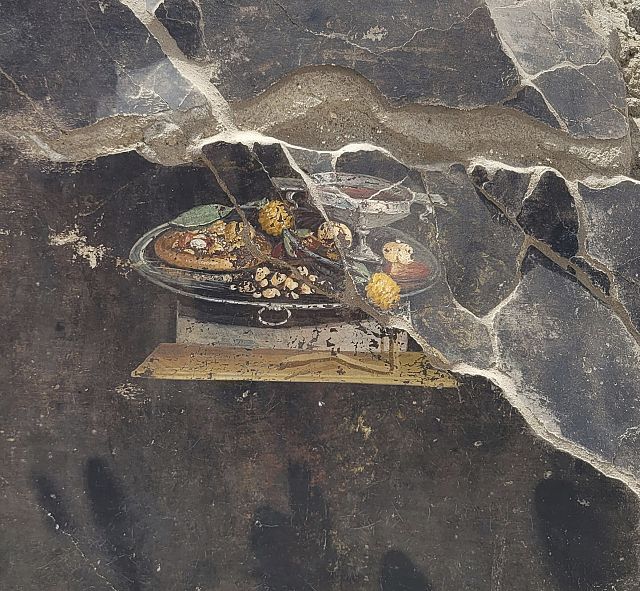
Interestingly, the place they sheltered was next to an oven, and not far from that was a fresco of what has been hailed as “ancient pizza.”
While the familiar modern version with tomato sauce base obviously did not exist, it’s interesting and comforting to see this hallmark of human cuisine across the gulf of time.
I love cooking, historical and otherwise, and I can reassure you that in all the research on food history, “protein encased in carbs” — aka “stuff baked on top of bread”; or in it, for that matter — is a universal staple.
That’s it for now. The finds and research from Pompeii keeps surfacing, so I’m sure this won’t be the last of the exciting discoveries and columns on the subject. Next time, though, I want to survey some of the spectacularly splendid sites of provincial Roman remains. ie Archaeology from further out than the Italian peninsula, from all across the Roman world.
I hope you found the insights into Roman culture as fascinating as I do. I take great care to fit these nuggets of human life and drama — all the tidbits about symbols and daily life to the eternity of the human condition — into the stories I write.
In Numina has been especially on my mind while reading this, what with the role the household gods play in it (especially when they aren’t propitiated properly). If you’ve read it, I’d love to hear from you! If you haven’t yet, why not enjoy the free short stories and novels until next time?
 FELIX THE FOX MYSTERIES