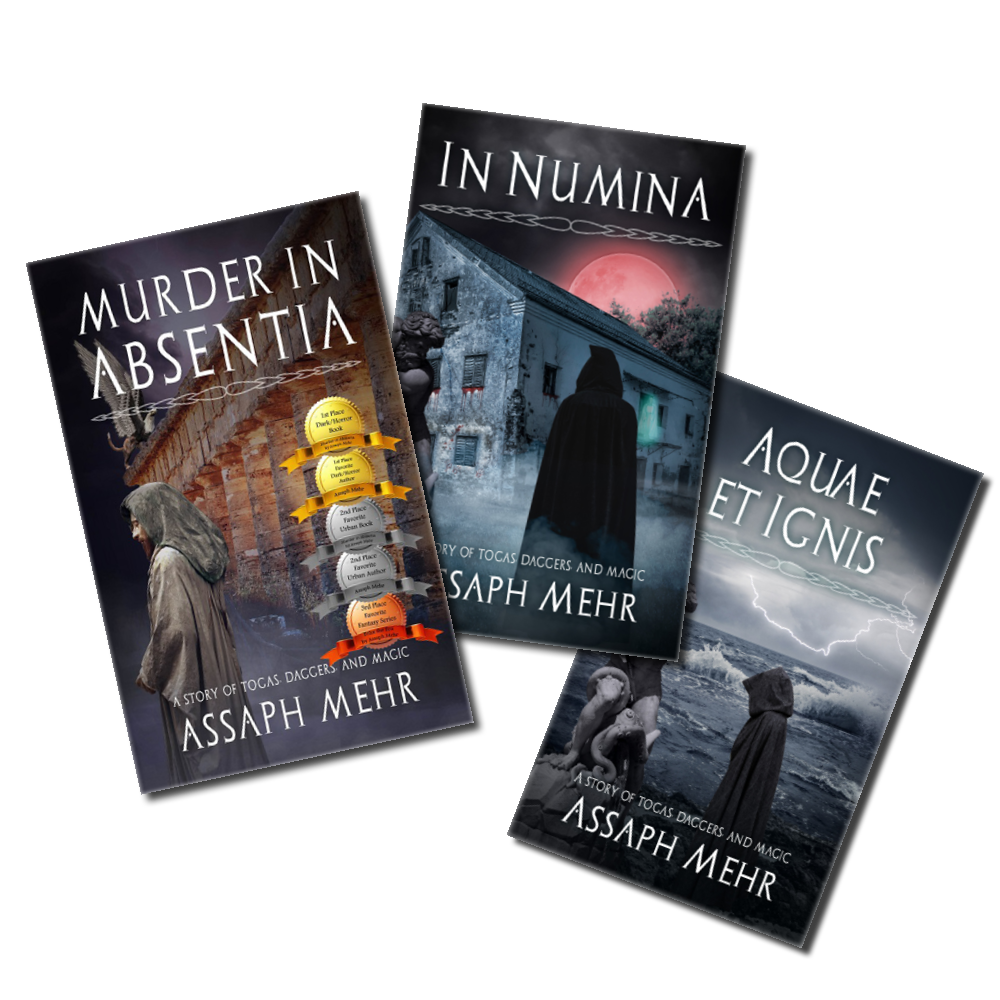
As mentioned in a previous post (the one with cats), in an effort to restart my writing habit and complete In Victrix I have re-read all my previous works. The idea is to get back into the world, and ensure a smooth continuations (culmination?) of the series.
Below are some observations, for the benefit of readers, authors, and my future self.
Gremlins
The books have been edited and proof-read repeatedly by professional editors. Also, close friends and random people pointed out typos, which were promptly fixed, and then followed by more professional proof-reading. And yet, on re-reading the works, some typos have crept in.
Nay, not crept themselves, but maliciously inserted by a nefarious tribe of publication gremlins. These sit inside the printers, and add them for every edition sent to the publishers.
I have no other explanation.
Roman time counting
The Roman way of counting time (backwards from certain key dates, bearing in mind that boundary dates count twice), is uniquely designed to confuse the enemy and generations of future students.
For example, the Nones — from the word nine — is the ninth day before the Ides. The Ides, of course are on the 15th of months with 31 days… or the 13th on months with 30 days. A one-day difference in month length makes two in the Ides. (That’s actually due to the Julian reform, because before that months were actually either 31 or 29 days, so he changes to 30 days length but didn’t move the Ides; serves him right, getting killed on the Ides).
So the nones are therefore on either the 5th or 7th day. Because 15 – 9 = 7, as we all know so well. As for the last day of the month, because the Kalends (1st of the month) is tomorrow we can say we’re at the day before the Kalends. But yesterday was 3 days before the Kalends. Why? Because on the 29th we count the-day-after-tomorrow as today-tomorrow-Kalends = three days. (Not that English is much better, with a single word for defenestration, but none for the-day-after-tomorrow).
At this point my hovercraft is full of eels 🤯. It’s why I keep a table of dates and events for each story, translating the Roman date into something digestible for modern humans. I also put in a few fudge days (like travel somewhere, or lying sick in bed), just in case I found out I made a mistake in counting and need to add or remove a day from the story.
Plots
I set out to make Felix a human being, not a superman. No stamina to survive wounds beyond what a normal person might, no insanely analytical powers of observation or photographic memory, no mad magical skillz. Simply a dogged determination to winkle out the truth, coupled with just enough knowledge about arcane matters to draw conclusions.
That then forced a certain pace, certain limits to the action. It couldn’t quite be a noir private dick going on a jog after getting shot, or a Sherlockian brilliance of deduction. It sat well with what was important to me, though now I can see that for stories we often don’t mind — or often actively seek — that larger-than-life protagonist and heroics.
So as the books progress Felix (hopefully) blunders around a bit less and the reader is kept more engaged, but there will always be these limitations of pace and plot (and who comes top whose rescue) by the very nature of his humanness contrasted with the forces of magic.
The fantastic
Speaking of magic, I clearly had more ideas than was good for me. Or for the books. This is in part why I built a fantasy world rather than rely on historical Rome + magic. I’m generally happy with how it turned out in the books, but there are a few references to stuff I could probably do without.
So while the mythical creatures — and the approaches to cooking them — are perfect, and the performative, contractual nature of Felix’s spells feels right, I think that some of the background theory and resultant structure of the various collegia was unnecessary.
I was also somewhat unsure at the start about Felix’s capabilities and bag of tricks, so that changed somewhat as the series progresses. To be fair, it’s common to a lot of urban fantasy series, so I’m not too fussed. I did stick to the rule of magic will never be the answer to his problems, will never do more than just speeds things a long a little without revealing anything material, in line with my note about plots above.
Oh well. A cautionary note about excessive world-building, and about focusing on what’s needed and how it feels, rather than any hard structures and rules. At least for me.
Names and places
Some of the names can only be blamed on the fact I was writing the first novel very late at night. I mean, the river ‘Fulvius’? Considering fluvius is a river and fulvus is tawny yellow, it’s kinda like calling your town’s river “Pissing Iver” 🤦
The two hills on the side of the bay are imaginatively called Septentrionali and Meridionali, or, in English, Northern and Southern. At least the island of the Pharos is called Insula Laridae — isle of seagulls. (Which, now that I think of it, might make it less fitting as a romantic hideaway).
Once we get out of the city things are a bit under better control, with names taken from historical Roman towns (spelling only slightly bashed), or loosely inspired by original local names, like Hellica for the Greek Hellas. Then again Mitzrania, based on the Hebrew word for Egypt, which is based on the Akkadian/Persian word (and came to be the modern Arabic name, Misr). So a bit of hit and miss.
Similar with people. While Roman and Greek(ish) names are mostly historically accurate and much care is given to ways of salutations (it irks me when other historical authors use the English sir, an honorific that would have been very uncharacteristic). But some of the others are either random (like Mahatixa and her trope) just there for the sound. The one exception is Zymaxis, which has a trope villain’s name very intentionally.
Style and tone
I come from the world of product management and start-ups, and one of the adages about releasing new products is that if you aren’t a bit embarrassed by the first version, you released too late. The good news is that I fulfilled that guideline with Murder In Absentia 😜
The even better news is that I definitely show improvement as the books progress. Probably a combination of experience, and editors that were patient enough to whack me repeatedly with a lead pipe over the head until I learned better. During my writing hiatus I did beta-read several novels for author friends. This isn’t professional editing, but it did allow me to objectively sharpen my literary skills, which I now turned on my own works. The distance of time allows one to get a clearer perspective (less enamoured, more choppy-choppy with darlings 😜).
One can see what was on my mind at the time I wrote each story. For MIA, it was indulging my love of Roman culture, while simultaneously being afraid to make historical mistakes and a bit obsessed about the fantasy world-building aspects. So the style was more tell-y than show-y, because I bloody well enjoyed exploring these topics.
While writing In Numina, I was not at a happy place and as a result there is a certain Lovecraftian flavour and a theme of frustration throughout. My wife still has nightmares about a few of the scenes, or at least that’s her excuse for not finishing the novel. The frustration is important to the plot of the novel and the series, though it stems from my own life at the time. But on the bright side, the writing style has improved, plot is progressing and better pace and cohesion, and I think — and damn the critics — that the trial with Cicero is awesome. Fittingly for the unofficial sub-title, a story of haunted and court houses.
The novella Aquae et Ignis is yet another step up. I wrote it soon after In Numina, but with the explicit aim of writing something lighter as an introduction to the series. (Even though events take place after book 2, the structure is that it can be read independently). It certainly flows a lot easier, with pop-culture references and action comedic scenes.
In Victrix, I believe, is another step up. It’s the full Felix experience, lighter on the practical magic but with more influences of the mysterious numina and Roman politics, an exercise of combining what I find appealing in noir detectives, cosy & courtroom mysteries, and twisted Roman events. It was also the most emotional of the novels, and I think I got just right.
In short, reading early works is a tad embarrassing, but seeing the improvement over time is encouraging. So if you’re a budding author, my best advice is to write the damn thing, get it edited (to the best of your budget), and then publish it and move on. You will only improve if you keep exploring new projects.
But you know what?
Despite all the embarrassing aspects, the heavy world-building and occasional slow diversion, despite the fact that I spent countless hours working and reworking them again and again so should know better, I loved (re)reading the books! I wrote these stories for myself, about the things I like the most, with the intent of entertaining myself. That other people like them, is just amazing!
More than that. I remember the ‘feeling’ while writing certain scenes. When I felt a buzz writing something, I felt the same buzz reading it — even rereading it for the umpteenth time after all this while. And that just makes me happy.
So my advice to you is…
If you’re an author, you should occasionally re-read your old works. Reflection is imperative for improvement. So a bit of time and fresh eyes will teach you a lot about your own little foibles and blind-spots, about what in your writing works (and should be polished to brilliance) and what doesn’t (and should be avoided or compensated for).
And if you’re a reader, even if your To-Be-Read list is longer than your life expectancy, it’s perfectly fine to reread works you love. Life’s too short, so you should enjoy everything you read, and damn the popular culture.
Until next time, Videas Lumen!
Enjoying the articles, but curious if I’m just full of it or really make use of those varied subjects? Happy to elaborate! Go meet Felix, the protagonist of the Togas, Daggers, and Magic series, an historical-fantasy blend of a paranormal detective on the background of ancient Rome.
You can Felix and his world on the free short stories and novels!
 FELIX THE FOX MYSTERIES
0 Comments