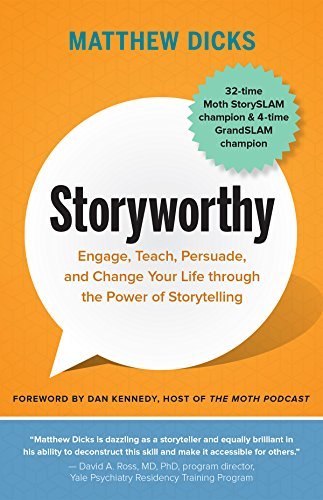
I’ve heard Matt Dicks on a podcast, and since I’m always trying to improve my storytelling craft I dove into his books as well.
What to Expect
Expect a very easy to read book, filled with stories and anecdotes that helps explain Dicks’ take on storytelling. Dicks takes you through recognising moments in your life that could make a good story (and indeed, what makes for a good story), and then how to polish it and deliver it.
What I liked
I loved the tone of the book, very conversational and approachable. Dicks clearly has a gift for teaching through storytelling, and uses it expertly to demonstrate the concepts and points he’s making. The advice itself isn’t earth-shattering new (as Dicks himself points out), but his take on it makes it much more understandable and usable.
What to be aware of
Dicks focuses on telling real stories, anecdotes out of his own life that help illustrate the point. The reality and personal angle are important to generate authenticity and empathy in the listeners (and thus deliver the message to an engaged audience). While he uses these stories in both storytelling competitions and in the classroom, you’ll need to take a critical eye and extrapolate some of the advice when writing fiction.
Also, as Dicks insists the stories must be real to be authentic and engaging, this type of storytelling requires intense vulnerability and willingness to share. The main technique that Dicks recommends in finding such story-worthy anecdotes to turn into full story is a form of journalling, and much goes about this and the openness in telling being almost a form of therapy. This may work for you, but for others like me (intensely private people), this may be daunting.
Felix’s and Jack’s Reviews
Rather than let Felix and/or Jack read the book, I used some of Dicks insights to analyse my own stories. For example, what is the 5-second moment when a character’s life changes by a fundamental insight? Or have I started as close as I could to the action, while setting enough background to make emotional moments more impactful to the reader?
I think I have managed pretty well, and I’ll examples below. But in general, my approach to this type of writing craft literature is to absorb (by reading and playing with the concepts in my mind), and let it percolate at the back while writing. Much of the magic of stories, just like the shine of diamonds, come with the polish of editing rather than the initial raw drafting. In those instances, the insights in this book can be tremendously helpful to a fiction novellist.
Waxing Philosophical (aka mild spoilers)
In this section I’ll ramble on about how Dicks concepts apply to my published novels. I’m curious whether you see this in them too — please let me know in the comments!
5-second moment
These are moments of realisation, where the character suddenly understands something fundamental in life that changes them. This change is important.
Take Murder In Absentia for example. Towards the very end Felix is absolutely stumped at how all the puzzle pieces fit together. He’s done all he could, talked to all the witnesses, reviewed all the evidence — and yet the crime couldn’t have possibly happened. At then, sitting demoralised and looking out across the Bay of Egretia, he goes “And suddenly I it understood.” as the whole thing clicks into place. What follows is a bit of am Agatha Christie-esque nail-biting unravelling of the mystery to all the relevant people.
But that isn’t the real 5-second moment. That is merely solving the crime. The real change in Felix comes when he walks out the door at the very last sentence of the novel, and he suddenly understands something about himself that changes who he is.
What is that change? That relates to the next section.
Arcs
In order to highlight the change in the character, there should be an arc that starts at the opposite state before the change. Murder In Absentia starts with a dream, a sort of flashback, where Felix faces a past failure that made his heart close to relationships. The book ends with the realisation that those are possible, and indeed desirable. Indeed, if you look at the three novels together, that’s the arc right there.
With In Numina there’s a strong theme of frustration. This works are part of the series arc (the book endings make up a high-low-high sequence). This is why the epilogue to the ook was so important. The arc there is between the opening lack of control of his life, to him making amends and inviting others as a mean to provide the grace he can.
Stakes and other techniques
Dicks talks about building up stakes, starting close to the action, stating problems and burying hints, and using language to control the tempo and distance. He comes up with his own names for these techniques (from elephants to breadcrumbs, from backpacks to milk cans), I just prefer the more traditional terms. Considering that novels are long-form narratives there’s usually more space and need to play and build up the stakes and other aspects.
Again, as a pantser I often focus on the story’s progression while drafting, and quite a few of these are added and polished during editing. One also needs to play with and around to genre tropes. Writing detective / crime fiction usually means that the story starts when the detective is presented with the crime to solve. Whether it’s Felix being hired or Jack being called out, there’s only a brief space to sketch the current situation, and finding the perpetrator drives the plot. Stakes — whiffs of danger and risk, personal involvement, or other aspects — can be added in various ways to keep the reader interested and reading. The same with pauses (to remind the reader of progress, and highlight the next bit of action), humour, foreshadowing. While Dicks doesn’t talk explicitly about pace and beats, his descriptions and illustrations of some of these techniques can help a writer when consciously editing a story to control those aspects.
I know I certain was very conscious of them when writing and editing. Some felt a natural place to insert something while working on the first draft, some only became obvious later. I had to prune some parts, add others, highlight or de-emphasise, and generally pay close attention to language to help control the pace.
For example, In Victrix incorporates the Titus Milo & Clodius Pulcher clash (well, a condensed version; the benefit of historical fantasy). To have the outcome of that clash hit hard, I have to make Clodius likeable, while still showing how his mercurial personality will lead to violence. Just read the opening scene: it sets the tone, it foreshadows, it builds up engagement through humour. That is also why, much later on, the celebration of Saturnalia is played on multiple levels. From humour (Aemilia’s allusions to Felix’s cooking) to touching personal moments (the gift giving and other tender moments). This breather is so important to make the fall that comes next hurt so much.
Summary
In all, when you think about the points Dicks makes: that the essence of stories is about moments of change, that to show them one must highlight this change, and the techniques to do so — I think I’ve done rather well. That isn’t a self-congratulatory note: I can certainly see points where I could have done better, and generally the improvement in my craft over time. But it’s a sign that I’m on the right path. I find it useful to read such books on craft, use my own stories as case studies to learn from, and then let this information sing into my subconscious and come up when I need it during drafting and editing.
Back to the book review. Overall, it’s a great book to read, even if not all the parts were relevant to me as a fiction author. I’d definitely recommend it for anyone who wants to improve their storytelling skills (which, considering how important communications are in life, should be almost anyone). There is certainly value if you want to follow his advice on journalling, self-examination, and vulnerability for anything from engaging audiences (whether at the dinner table or at work) to self-therapy, but even if you don’t there is still a lot of good, practical advice about understanding stories and crafting them. Whether you apply it moderately to selected incidents and private audiences or in your craft as an author, it’s a great resource and good skills to have in life.
Enjoying the reviews, but wondering who the heck are those Felix and Jack fellows? Glad you asked! Felix is the protagonist of the Togas, Daggers, and Magic series, an historical-fantasy blend of a paranormal detective on the background of ancient Rome, and Jack is the police detective running the Unusual Crimes Squad, dealing in occult crimes in modern-day Australia.
Come meet Felix and Jack on the free short stories and novels!
 FELIX THE FOX MYSTERIES