I see variations of this floating around the net:

Funnsies aside, here’s an explanation of why authors find it hard to write blurbs for their own books (so you feel smarter) and what to do about it (so you can act smarter).
Why do we find it hard to blurb our books?
This comes down to a few cognitive biases. The curse of knowledge is a cognitive bias where someone with a lot of knowledge about a subject finds it hard to place themselves in the position of those who don’t. We as authors are obviously deeply knowledgeable on the epic we’ve just written, and we can’t imagine it from the outside.
Then there’s complexity bias, a tendency to evaluate complex solutions as better than simple ones. (Don’t worry, simplicity bias — the tendency to over-simplify things — is also a thing). Being experts on all the intricacies of the novel, we can’t see how we just reduce it to two sentences.
I’m sure there are more. Not only are humans complex with many biases, we authors have multiple voices in our heads, each with their own set of issues and all shouting at us at the same time 😅
But now that we know what causes this (our detailed view of the complexities in the novel), we know how to fix it.
How to fix it
How many times have you picked a book and felt this:
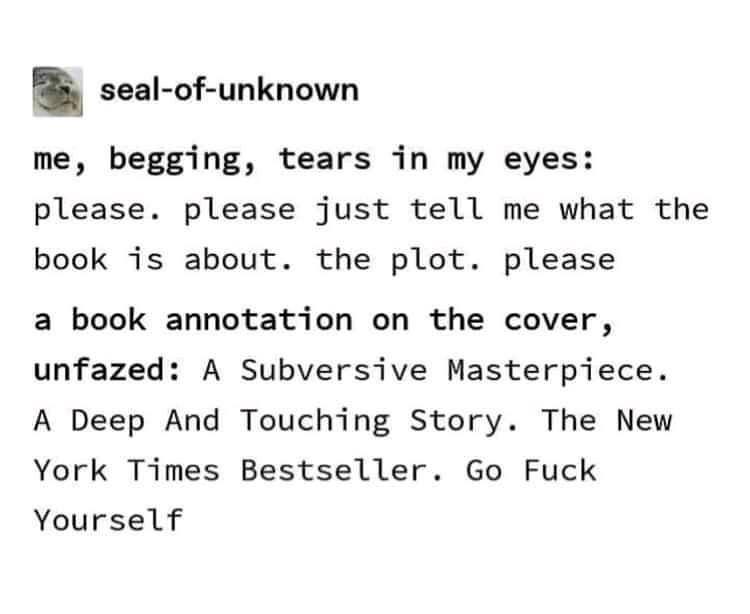
Again with the chuckles 😄 In some cases publishers can get away with it. If you’re publishing another James Patterson book, people buy it because of his name rather than any title or plot. The rest of us need a bit more to attract readers. Readers who want a clue about what to expect from the pages behind that gorgeous cover they just picked up.
But that’s exactly the point. They know next to nothing about you and your novel. You must have felt the same when you last picked a random book at the shops or library. When evaluating a book, there’s an order getting the right people engaged (a marketing funnel):
- The cover is to catch the eye and make a promise of genre & tone
- The blurb is to set expectations about what’s inside
- The opening is to make a promise about the journey of reading
Each one must match what’s actually inside, and help readers determine if it’s right for them. Its also why covers and blurbs need to be a bit bland, and conform to genre expectations. You’re never alone in a category, or we’d all be best-selling authors 😜 But the point is that the cover and blurb (as well as the story itself) need to fit on a ‘mental shelf’ for the reader, so they can correctly asses if that’s the book for them now.
Back to blurbs, there is lots of advice and formulas out there. There are certain general elements (introducing the main character and the challenge they’ll face, some social proof in form of reviews, adding ‘x meets y’ or ‘for readers who enjoyed z’ comparisons), but the formulas aren’t as important as the view point. You should try and think as a person who has no idea about the book, and make them a promise about what they’ll encounter inside, how reading it will feel.
It’s time to forget all that you know about the novel, all the richness of details you’ve built into the background, all the clever plot twists, all the quirky characters. Just add 2-3 sentence about the character and the challenge they’ll face in a way that sets expectations about what the reader would feel.
I’m not saying I’ve nailed it with my novels, but since I’ve tweaked the blurbs and keywords some time back I did see an improvement. I occasionally keep playing with the format (on Amazon, at least), to see what works better. My main goal is to grab the attention of the right readers:
- Within the first 10-15 words I set a broad expectation of the time period and magic/mystery elements. (Think subtitle or headline / catchphrase of the blurb).
- Within the following 30-50 words I try to give them a quick taste of what they’ll encounter inside.
- If they read that far, I present them with reviews by the most famous people who read the books, as proof that the work has some merit.
I actually think I went a bit too long on the second point above with In Victrix. Probably time to tweak it and see. They key is, again, not to lose sight of the prospective reader. How do I attract those who like tight fantasy with some historical background, and help those who like epic fantasy or pure historical fiction understand that this novel isn’t one of those?
If you’re stuck…
When debugging code, there’s a method called ‘rubber duck’ debugging. That’s when you patiently explain to a rubber duck all the issues, until you come to some realisation about the source.
In this day and age, the duck can talk back if you use some AI chatbot. Now, we all know that AI is rubbish when it comes to writing (to say nothing about the ethical and environmental issues). However, it spewing some sort of bland formula may be the right direction for the blurb, precisely because it does a completely unimaginative job.
Not that I recommend you use what it spits back, but at the very least it’s a motivation to show it how it’s really done. I mean, surely we human creators can do a better job, right? 😜
But more seriously, look at other best sellers in the category, and figure out the kind of language and structure they use. Take a moment of critical thinking, and try to see if you recognise patterns and how you can apply the same to your novel in a slightly bland way that ignores the complexities and attracts the same readers.
Summary
Whether you treat marketing as a science and want to delve into cognitive biases and experiment with different formats, or whether you just want to get something done and move on — focus on that moment when someone who doesn’t know anything picks up a copy and flips it over. What can you quickly promise them that you’ll deliver inside, never mind the details of how it’ll play out? How can you match the similar language and structure of other works in the genre, so readers know what to expect?
Forget all the intricacies and knowledge you have, and think what you’d like to know when picking up similar book. Write the blurb to that version of yourself.
Bonus
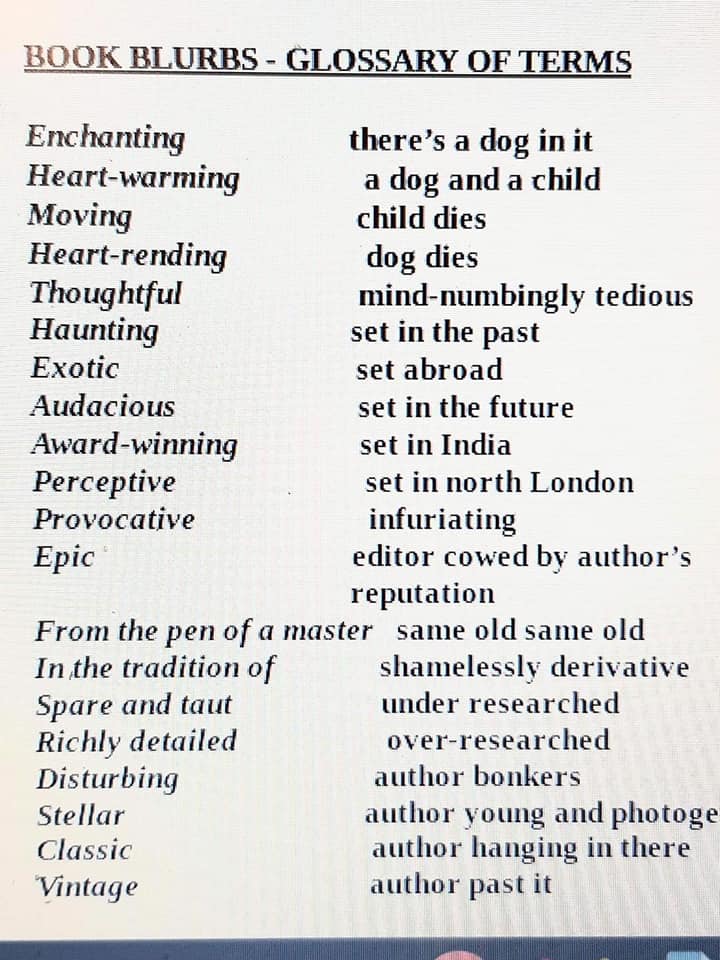
If you’re still stuck, here’s a little cheat-sheet of terms you’ll encounter on back covers:
 FELIX THE FOX MYSTERIES