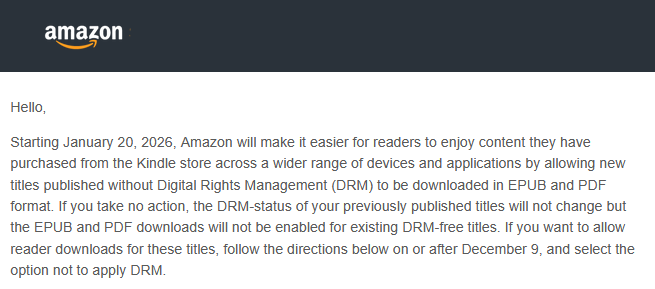
Amazon just made purchased ebooks downloadable as ebook and PDF, and I’ve been hearing a lot of concerns. Here’s why you shouldn’t worry.
The two key concepts you have to understand are that:
- Amazon DRM never stopped piracy
- Amazon is only concerned about their profits — yours are incidental to that
I think the second point is pretty clear. While Amazon has a “customer focus” that applies to the one with the wallet, ie the reader. Small publishers (indies and others) are considered in aggregate as a necessary evil. The point is to maximise Bezos’ ability to go on space tourism, so the platform is there just to provide you with enough incentives to stay and maximise said profits.
This means that DRM protections are not built to help indie authors and publishers, but are there to minimise the reduction is profit piracy has. With that in mind, let’s look at what actually happens with book piracy.
We’ll start with that there are two distinct groups within that ecosystem. The first is those that distribute copyrighted books across the web. They do this out of an “information should be free” idealism, which fails to understand that in trying to hurt Amazon (and other retailers) they mostly hurt the authors and artists. What they don’t do, is actually read or care much about the books — it’s all about the mass distribution of digital assets.
Then there are the readers. A reader who decides to download a book from a pirated site has already decided not to pay. In that respect, it not a lost sale because you never (or practically never) would have made that sale. They decided to spend their money elsewhere, but still want to read a book; so they’ll find something that won’t cost them money.
My first book as an absolute-nobody author has appeared on pirated sites with 12 hours of publication, by a user who uploaded 20 books that day. The second book I myself proactively uploaded a cut-down versions, so it took them a few months to notice and pirate a full copy. With the third book I didn’t bother and it took almost a year to appear on pirated sites; I was vaguely insulted at my declining popularity 😜
In that respect, and in order to reduce your needs for antacids, it’s better to think of pirated sites as the Big Library in the Sky, a way to reach new readers and bring joy to them, rather than a means of funding retirement. It may not be fair, but it’s better for your mental health.
But won’t DRM stop all that so I can make money off my art? you ask.
Well, no. For two reasons.
First, is that DRM never stopped the book pirates. Technically, DRM means that books are encrypted and can only be opened by the device that has the decryption key. Practically, once you have a device you can figure out the encryption method and key, and decrypt it outside of the device. And because they process books in bulk, it’s practically automated so that DRM it removed as part of downloading and distributing the books.
The new KFX-based DRM from Amazon (books released after Feb 26, 2025) is a bit harder, and I don’t think it has been broken yet. Still, releasing new encryption methods is a game of cat and mouse, and only delays pirates by a bit until they adapt to it. It will never stop piracy because the motivation is ideological (misguided, but still), and you only need one technically competent hacker to develop the bypass which gets taken up by hoards of pirates (which process the vast number of new book releases). And, of course, if you went wide, there are existing ways to break Kobo et al books (Amazon just makes it easier for pirates by offering refunds for ebooks). Meanwhile, those readers who decided not to pay for books will just read something else until the new book is released to pirated book sites.
The second reason you won’t make money off books has nothing to do with piracy, but about the balance of power in capitalism. Authors have always struggled to live off royalties, a situation that has been worsening for decades. Partly this is capitalism working as intended, and partly it’s the mathematical certainty of the rich get richer. This principle means that any small advantage at the start, like luck, can lead to outsized effect later. (Don’t get me wrong, you need to put in the hours of practice to improve and be able to take advantage of lucky breaks — but there is still a huge impact of those lucky breaks that no successful person likes to admit to.)
The only ways I know that make a living wage off writing fiction are:
- Get super lucky, and get your trad-published books picked up by thousands of readers, repeatedly (marginally better than lottery chances)
- Write and publish 4+ Romance books per year, and advertise a lot (feels too much like work)
- Win the lottery, so you can retire to write (infinitesimal chances, but has other perks too)
Options 1 and 3 are statistically implausible. Option two works particularly in Romance (with a smattering of successes in other genres), and is based on quickly building a back catalogue of multiple series of 5ish books, ands then advertising to a readership that consumes in bulk. I’m in awe of writers who can produce so much, but I don’t have it in me.
Sooo… to DRM, or not to DRM?
At this point you probably think “yeah, whatever, screw the pirates but at least it won’t do any harm if I turn DRM on.”
Well, actually…
I used to download all the books I bought on Amazon and back them up until they disabled that option. I don’t like it when I “buy” something and it turns out that I only bought the temporary access rights to it, and if the algorithm has a bad day Amazon can lock me out of my own library. So I keep a copy — paid for! — outside my Kindle.
By introducing DRM and disabling downloads, Amazon isn’t really doing anything against piracy but they are inconveniencing legitimate readers and making things hard for them. So they could lock them out, if they feel like it. This whole “Your books will be downloadable unless you enable DRM” is actually Amazon’s sneaky way to scare authors and ensure things stay within their ecosystem (because it’s the legitimate readers who will lose access, not the pirates). All so they can better fund Bezos’ space dick.
For what it’s worth, I never enabled DRM. If someone buys my book, they should have a copy. If someone can’t (or won’t ever) pay for a copy, well, at least they might enjoy it enough to leave a review, or even just have a better day after reading it from whatever life inflicts on them. At least my stories are being read.
As for money, I know what my chances are between the three methods above. I’d rather concentrate on the joy of writing and reaching new readers, improve my craft until the inevitable collapse of capitalist society*.
(* Capitalism may collapse, and even human nature may some day be reconfigured to be more appreciative of arts and artists. But reaching readers still operates under a mathematical model of ‘rich get richer,’ so luck always plays a role on which works get noticed in large numbers).
Bonus!
Mark Lawrence published this flowchart on Facebook. Pretty much sums it up — unless you’re talented AND extremely lucky, you’re best bet is to just enjoy writing for the sake of it. Even a successful, famous fantasy author is basically telling you not to stress and have some fun 🙂
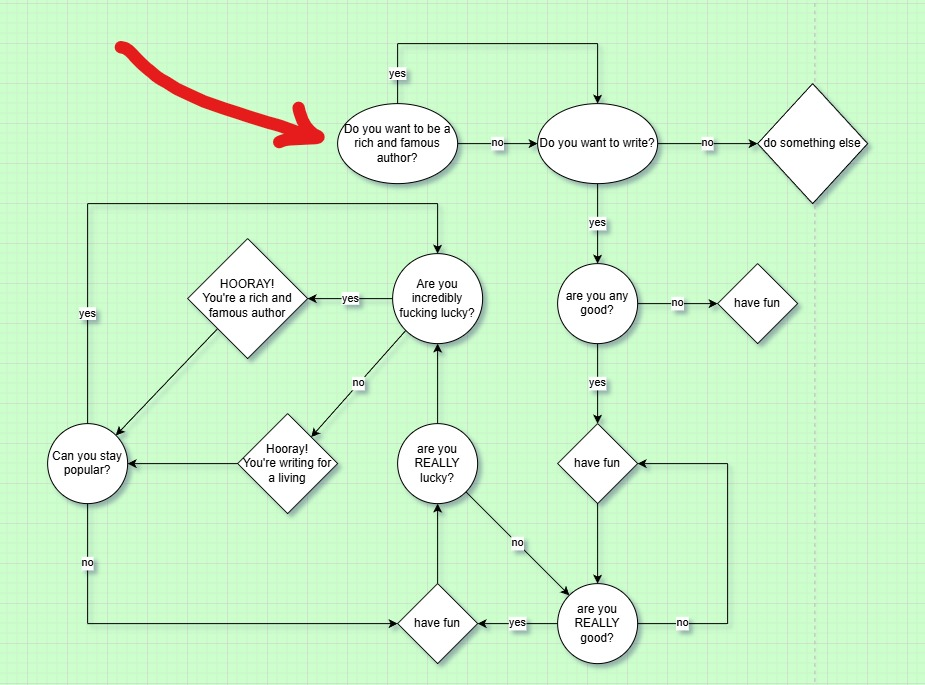
Do art because you enjoy it. Pursue passion, not money. Art historically never paid well, and that’s unlikely to change. You’ll need the motivation to keep going when it’s hard because, perversely, that’s the only path to success. It’s also the better path to sleeping peacefully at night.
As for my works, you can find free short stories here, and my full novels on Amazon or the pirating site of your choice. Felix has already given up on getting royalties (I fear he’ll burst Jack’s bubble pretty soon), and they both would just like you to enjoy the time with them.
 FELIX THE FOX MYSTERIES